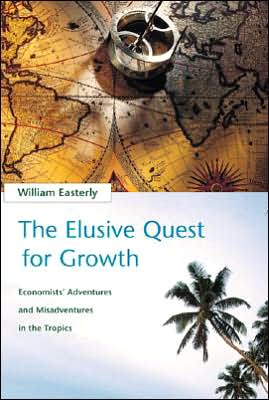
 Overview: Since the end of World War II, economicsts have tried to figure out how poor countries in the tropics could attain standards of living approaching those of countries in Europe and North America. A myriad of remedies has not delivered the solutions promised. The problem is not the failure of economics, William Easterly argues, but the failure to apply economic principle to practical policy work.
In this book, Easterly shows how these solutions all violate the basic principle of economics, that people-private individuals and businesses, government officials, even aid donors-respond to incentives. Written in an accessible, at times irreverent, style, Easterly’s book combines modern growth theory with anecdotes from his fieldwork for the World Bank.
«The Elusive Quest for Growth is a terrific book. Those who read it will put it down chastened, instructed and entertained.» -The Economist
«This is impossible to convey the depth and range of The Elusive Quest for Growth. Not only does it offer a persuasive argument but it summarizes, readably, a vast amount of research, making it come to life with real-world examples.» -Bruce Bartlett, Wall Street Journal
This is a brilliant, original work. It is simply the best book I know of on economic development. Easterly writes with clarity, honesty, and humor. And he is courageous in his analysis of what went wrong with the development policies followed by the World Bank.» -Sergio Rebelo, Tokai Bank Distinguished Professor of International Finance, Kellogg Graduate School of Management, Northwestern University
«Every college student who protests against free trade…should read this extraordinary book. Easterly presents both the power of simple economic models of the development process and the painfully disappointing track record of official development assistance. He writes beautifully and cares deeply about his subject.»-Paul Romer, Graduate School of Business, Stanford
«William Easterly knows his way not only around economics but also around the developing world. He has written hard-nosed book about the hardest problem of all; how to get the poorest countries on a path of sustained growth.» –Robert M. Solow, Institute Professor of Economics, Emeritus, Massachusetts Institute of Technology, and Nobel Laureate in Economics (1987)
«[Easterly] wears the good-humored but weary resignation of a lifetime idealist mugged at last by reality.» -Ken Ringle, Washington Post
Source http://www.nyu.edu/fas/institute/dri/Easterly/index.html
Depuis la fin de la Seconde Guerre mondiale, les économistes ont cherché à comprendre comment les pays pauvres pourraient rejoindre le niveau de vie des pays développés d’Europe et d’Amérique du Nord.
Ils ont inventé nombre de solutions prétendument miracles, qui ont été relayées par les politiques publiques d’aide au développement, mais dont aucune n’a tenu ses promesses : l’écart entre les pays riches et les pays en voie de développement n’a cessé de se creuser. Pourquoi ces échecs répétés et d’autant plus graves qu’il s’agit de vies humaines et de peuples entiers ? A travers analyses, récits et anecdotes vécues, ce livre est une critique pénétrante des politiques d’aide au développement qui ont été mises en œuvre un peu partout dans le monde, principalement sous l’égide du FMI et de la Banque mondiale, et des théories de la croissance qui les sous-tendent.
Mais il ne s’arrête pas là et explore les solutions possibles pour sortir du sous-développement.
 Fabiana Zonis
Hello I am so grateful I found your website, I really found you by mistake, while I was researching on Aol for something else, Regardless I
am here now and would just like to say kudos for a marvelous post and a all round entertaining
blog (I also love the theme/design), I don’t have time to read through it all
at the minute but I have bookmarked it and also included
your RSS feeds, so when I have time I will be back to read much
more, Please do keep up the excellent work.
Me gustaMe gusta
Thanks a lot for your wonderful feedback.
I will greatly appreciate all constructive comments and feedback you may have. Please feel free to leave comments and share thoughts on the blog .
Keep reading the blogs like this.
Thanks for appreciating my efforts.
Me gustaMe gusta