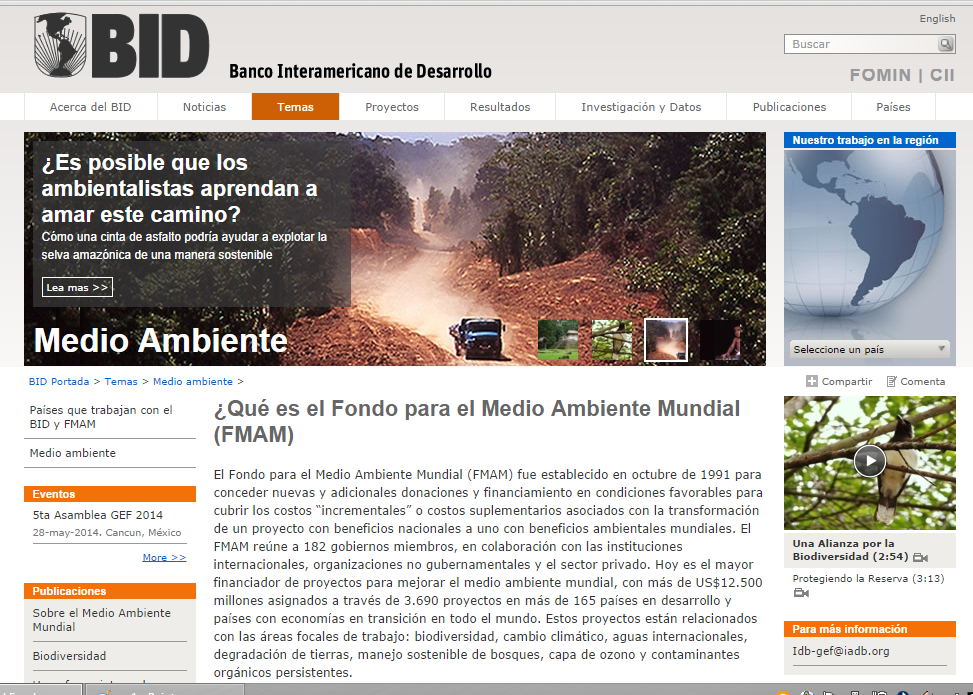
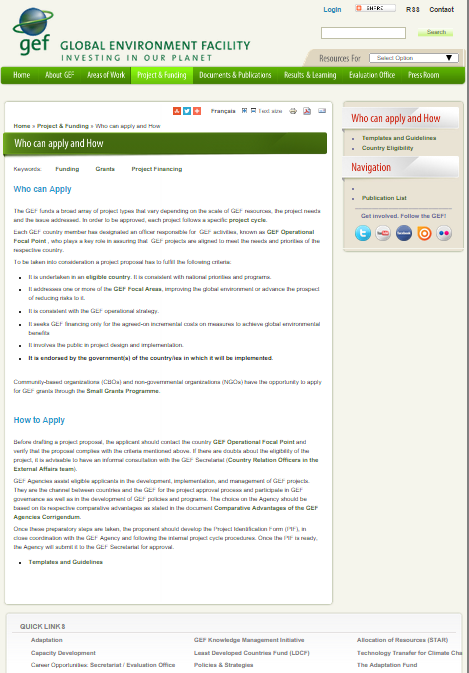
 El Fondo para el Medio Ambiente Mundial (FMAM) fue establecido en octubre de 1991 para conceder nuevas y adicionales donaciones y financiamiento en condiciones favorables para cubrir los costos “incrementales” o costos suplementarios asociados con la transformación de un proyecto con beneficios nacionales a uno con beneficios ambientales mundiales. El FMAM reúne a 182 gobiernos miembros, en colaboración con las instituciones internacionales, organizaciones no gubernamentales y el sector privado. Hoy es el mayor financiador de proyectos para mejorar el medio ambiente mundial, con más de US$12.500 millones asignados a través de 3.690 proyectos en más de 165 países en desarrollo y países con economías en transición en todo el mundo. Estos proyectos están relacionados con las áreas focales de trabajo: biodiversidad, cambio climático, aguas internacionales, degradación de tierras, manejo sostenible de bosques, capa de ozono y contaminantes orgánicos persistentes.
El FMAM es también el mecanismo financiero designado para establecer una serie de acuerdos ambientales multilaterales (AAM) o convenios; y como tal, el FMAM ayuda a los países a cumplir con sus obligaciones en virtud de los convenios que han firmado y ratificado. Estas convenciones y acuerdos ambientales multilaterales proporcionan orientación a los dos órganos rectores del FMAM: el Consejo del FMAM y la Asamblea del FMAM.
Principales convenios:
• Convenio sobre la Diversidad Biológica (CDB)
• Convención de las Naciones Unidas sobre el Cambio Climático (CMNUCC)
• Convenio de Estocolmo sobre Contaminantes Orgánicos Persistentes (COP)
• Convención de las Naciones Unidas de Lucha contra la Desertificación (CLD)
The Global Environment Facility is a partnership for international cooperation where 183 countries work together with international institutions, civil society organizations and the private sector, to address global environmental issues.
Since 1991, the GEF has provided $12.5 billion in grants and leveraged $58 billion in co-financing for 3,690 projects in 165 developing countries. For 23 years, developed and developing countries alike have provided these funds to support activities related to biodiversity, climate change, international waters, land degradation, and chemicals and waste in the context of development projects and programs.
Through its Small Grants Programme (SGP) the GEF has made more than 20,000 grants to civil society and community based organizations for a total of $1 billion.
Among the major results of these investments, the GEF has set up protected areas around the world equal roughly to the area of Brazil; reduced carbon emissions by 2.3 billion tonnes; eliminated the use of ozone depleting substances in Central and Eastern Europe and Central Asia; transformed the management of 33 major river basins and one-third of the world’s large marine ecosystems; slowed the advance of desertification in Africa by improving agricultural practices—and all this while contributing to better the livelihood and food security of millions of people.
The GEF serves as financial mechanism for the following conventions:
- Convention on Biological Diversity (CBD)
- United Nations Framework Convention on Climate Change (UNFCCC)
- Stockholm Convention on Persistent Organic Pollutants (POPs)
- UN Convention to Combat Desertification (UNCCD)
- Minamata Convention on Mercury
- The GEF, although not linked formally to the Montreal Protocol on Substances That Deplete the Ozone Layer (MP), supports implementation of the Protocol in countries with economies in transition.
The GEF administers the LDCF and SCCF which were established by the Conference of the Parties (COP) to the UNFCCC. The GEF also administers the Nagoya Protocol Implementation Fund (NPIF) that was established the Convention on Biological Diversity (CBD). In addition, the GEF Secretariat hosts the Adaptation Fund Board Secretariat.
 Fabiana Zonis