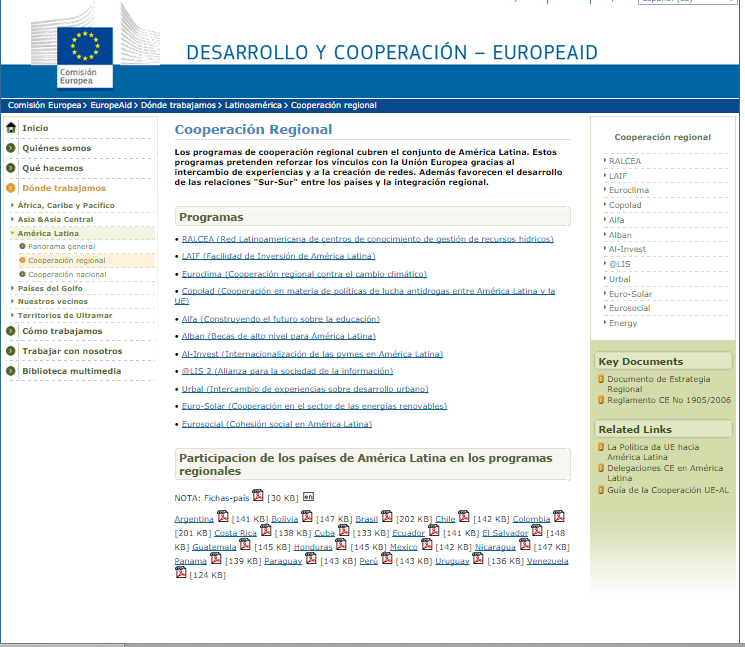
Cooperación Regional
Los programas de cooperación regional cubren el conjunto de América Latina. Estos programas pretenden reforzar los vínculos con la Unión Europea gracias al intercambio de experiencias y a la creación de redes. Además favorecen el desarrollo de las relaciones «Sur-Sur» entre los países y la integración regional.
Programas
• RALCEA (Red Latinoamericana de centros de conocimiento de gestión de recursos hídricos)
• LAIF (Facilidad de Inversión de América Latina)
• Euroclima (Cooperación regional contra el cambio climático)
• Copolad (Cooperación en materia de políticas de lucha antidrogas entre América Latina y la UE)
• Alfa (Construyendo el futuro sobre la educación)
• Alban (Becas de alto nivel para América Latina)
• Al-Invest (Internacionalización de las pymes en América Latina)
• @LIS 2 (Alianza para la sociedad de la información)
• Urbal (Intercambio de experiencias sobre desarrollo urbano)
• Euro-Solar (Cooperación en el sector de las energías renovables)
• Eurosocial (Cohesión social en América Latina)
Regional Cooperation
The Regional Cooperation Programmes cover the whole of the region of Latin America. They aim to reinforce ties with the European Union through the exchange of experiences and the creation of networks. Furthermore, they foster the development of “South-South” country relations, as well as sub-regional integration.
Regional cooperation with Latin America: 18 years of experience and more than €1 billion of investment
The first regional programmes with Latin America were launched by the European Union in the early 90’s. At that time they mainly concerned co-operation in the field of higher education, support to SMEs and local urban development.
Since the beginning of the 2000s, new regional programmes were formulated in accordance with the priorities defined by the successive European Union (EU) and Latin America and Caribbean (LAC) Summits. Endorsed by the Head of States and Governments of the EU-LAC countries, regional co-operation initiatives had a strong legitimacy and translated political priorities of the bi-regional partnership into concrete actions.
Regional cooperation represents a privileged tool to share with Latin American partners experience and know-how of Europe as a region. Particular attention is paid to the promotion of a dialogue and joint actions with international institutions that are active in LA (ECLAC, UNDP, IADB, OECD, and others). It is important to mention that the participation in regional programmes is open to all Latin American countries including Cuba. The networks of partners involved in regional co-operation initiatives include national governments, judiciary, legislative bodies, local authorities, private sector (enterprises, banks and intermediary institutions) and the academic world (universities, research and training centres). Ultimately, regional programmes became the main tool to promote South-South co-operation among the countries of the Latin American continent.
The current regional cooperation is designed around three key priorities which are social cohesion (EUROsociAL, Urb-AL, Al-Invest); sustainable development and climate change (EURO-SOLAR, EUROCLIMA, RALCEA and FLEGT South America) and promotion of higher education and research (ALFA and Erasmus Mundus). In 2010, the European Commission launched the Latin American Investment Facility (LAIF), a blending instrument to support public investment in strategic sectors.
The total of the European contribution to regional cooperation with Latin America since its beginning accounts for more than €1 billion.
EU-Latin America Regional Cooperation programmes
The EC has earmarked an indicative amount of €556 million for Latin America, for the period 2007-13, to support the following regional programmes: the second phase of EUROsociAL which aims at improving social cohesion and the Urb-AL 111 programme to pursue territorial cooperation; AL-INVEST IVto support the internationalisation of Latin American SMEs; LAIF, which enables the financing of important projects in different areas such as infrastructures, energy, transports, health and education; in the area of Higher Education, the ALFA IIIprogramme focuses on co-operation with higher education systems in LA, as well as the reinforcement of established partnerships between Higher Education Institutions from both regions; Erasmus Mundus with Latin America provides scholarships and promotes academic exchanges; in the sustainable development and climate change sector there is EURO-SOLARwhich aims at promoting the use of renewable energy sources,EUROCLIMAto improve the knowledge of LA decision-makers on the problems and consequences related to climate change, RALCEAto support the establishment of a network of knowledge centres in the water sector and the FLEGT South America project on Forest Governance that was launched in 2012; the @LIS 2programme continues to facilitate the integration of Latin American countries into the global information society; both COPOLAD,a cooperation programme aiming at improving the coherence, balance and impact of drugs policies, and the EU-CELAC project on Migration were launched in early 2011.
 Fabiana Zonis
Thank you for the auspicious writeup. It in truth used to be a
amusement account it. Look complex to far delivered agreeable
from you! However, how could we communicate?
Me gustaMe gusta