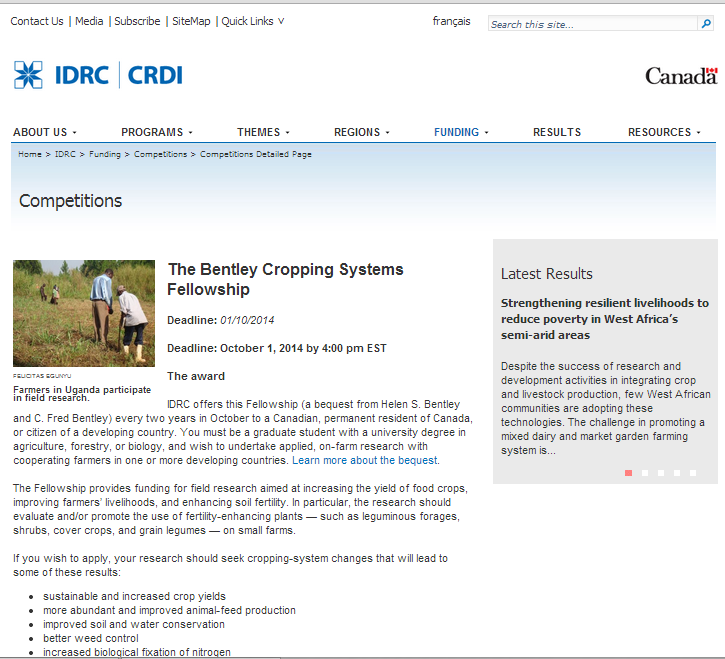
IDRC offers this Fellowship (a bequest from Helen S. Bentley and C. Fred Bentley) every two years in October to a Canadian, permanent resident of Canada, or citizen of a developing country. You must be a graduate student with a university degree in agriculture, forestry, or biology, and wish to undertake applied, on-farm research with cooperating farmers in one or more developing countries. Learn more about the bequest.
The Fellowship provides funding for field research aimed at increasing the yield of food crops, improving farmers’ livelihoods, and enhancing soil fertility. In particular, the research should evaluate and/or promote the use of fertility-enhancing plants — such as leguminous forages, shrubs, cover crops, and grain legumes — on small farms.
If you wish to apply, your research should seek cropping-system changes that will lead to some of these results:
- sustainable and increased crop yields
- more abundant and improved animal-feed production
- improved soil and water conservation
- better weed control
- increased biological fixation of nitrogen
Projects should be planned and executed in cooperation with an international agricultural research centre, or with a developing-country institution involved in agricultural research that has an applied, on-farm orientation.
Proposals must present plans for on-farm experiments on smallholder farms that have potential to improve the lives of farming households and to preserve or improve crops yields.
Key Selection Criteria
a) Focus of the Research
Proposals must focus on very simple cropping-systems research that can benefit smallholder farmers in developing countries, especially rural women farmers.
b) Participatory Research
Your research must involve simple experiments to be carried out by cooperating farmers under guidance of the researchers (see details about the location of individual on-farm experiments). Both male and female farmers should participate actively. They should be involved in all stages of the experiment on their land, including land preparation, seeding, and harvesting.
Who can apply
To be eligible, you must:
- be a citizen or permanent resident of Canada, or a citizen of a developing country;
- be enrolled full-time at a recognized university at the master’s, doctoral, or post-doctoral level in Canada or in a developing country for the duration of the award period;
- have a university degree in agriculture, forestry, or biology;
- submit a research proposal focusing on very simple cropping-systems research that can benefit smallholder farmers in developing countries, especially rural women farmers;
- provide evidence that you will be supported by local institutions that have a good working relationship with target communities, farmers, and/or extension agencies;
- indicate that you will seek cooperation, help, and support from local «extension officers» and/or NGOs in the identification of individual farmers who are likely to be suitable and cooperative;
- provide evidence that a large part or all of the research will be carried out on the farms of resource-poor or smallholder farmers. The award will not support research carried out on the farms of large landholders or on research stations;
- provide evidence that farmers will actively participate in the experiments. It is essential to develop simple on-farm experimental designs with appropriate controls to determine the practicality and profitability of introducing a leguminous crop or other fertility-enhancing plant in the farmers’ cropping systems.
If you are selected for an award, you have up to 12 months to start your field research from the date of the final selection.
How to apply
- Complete the eligibility and application forms online.
- Upload scanned copies of the documents listed in the checklist (PDF, 203KB)
- Your application must be complete, and submitted to the Centre by the deadline. Incomplete applications will NOT be considered.
- Your application should be submitted in English or French ONLY (Canada’s two official languages).
If you encounter problems when filling out your online application or have questions, contact us at awards@idrc.ca.
We will only consider applications submitted online through the link provided above. Please read carefully the information and eligibility criteria provided on this page before beginning the application process.
Guidelines for proposals
Make comparisons between traditional and alternative cropping practices
Your proposal must include details of the comparisons you envision between the traditional cropping practice used by farmers in the region and the side-by-side alternative cropping practice you wish to introduce. Experiments must compare crop yields from traditional unicrop practice with yields of the same crop combined with some kind of fertility-enhancing plant grown either simultaneously with the traditional crop, or in some cases, grown before the traditional crop is planted.
Please consult this diagram (PDF, 82KB) showing how a simple on-farm experiment might be compared to either one or two alternative cropping systems.
Similar experiments executed in rural school gardens — conducted with the help and advice of the Fellowship holder and with the participation of both students and teachers — are also encouraged.
Indicate wide dissemination strategies
The research procedures must include extensive dissemination of the results aimed at smallholder farmers, including rural women farmers. You should
- present the results in formats — such as field days, farmer visits, and briefs for policymakers — that will reach the various stakeholders
- actively involve farmers, extension workers, local development initiatives, and agricultural organizations in dissemination efforts
- include farmers’ visits and farmer-to-farmer teaching and learning in the outreach.
Outline how the proposed experiment will be sustainable
You should suggest the anticipated benefits/improvements and feasibility of your proposal. Please explain
- how the research data was collected and how the introduction of leguminous plants or other fertility-enhancing plants in cropping systems is expected to improve the economic benefits to farmers
- how you will make the frequent trips from the «home base» to the villages of the cooperating farmers. This is essential for successful execution of on-farm tests.
Countries subject to approval
In principle, IDRC supports research in all developing countries. At this time, however, we do not support awards that involve research in Cuba, Iran, Iraq, Korea (Democratic People’s Republic of), Somalia, Eastern Europe or Central Asia.
IDRC must approve field research proposed in the following countries or territories prior to issuing the award:
Afghanistan, Central African Republic, Chad, Congo Brazzaville, Congo (Democratic Republic of), Eritrea, Gabon, Guinea Bissau, Liberia, Libya, Mali, Niger, Papua New Guinea, Small Island States [including Comoros, Equatorial Guinea, Mauritius, São Tomé and Principe, Seychelles, Timor-Leste and Oceania (Cook Islands, Fiji, Nauru, Kiribati, Palau, Marshall Islands, Niue, Samoa, Solomon Islands, Tokelau, Tuvalu, Tonga, Vanuatu, Wallis & Futuna)], South Sudan, Sudan, Syria, West Bank and Gaza, and Yemen.
Duration
Award tenure corresponds with the period of field research. In general, it will be between 18 and 24 months.
Value
The value of the award is up to CA$30,000. If there is strong evidence of significant potential benefits, the award may be extended upon re-application.
Progress Reports
Fellowship holders will commit to provide IDRC with three brief progress reports per year.
Deadline
October 1, 2014 by 4:00 pm EST (the award will be announced by mid-December 2014). You must begin your fieldwork by December of the following year.
Evaluation criteria
Applications will be evaluated according to IDRC thematic priorities and criteria, such as relevance to sustainable and equitable development, as well as quality of the research proposal and suitability of the candidate.
Reapplication policy
If you are reapplying and your previous research proposal was reviewed and unsuccessful, please explain, in the application form, what changes have been made since the last application and specify where to find the changes in the proposal. Please note that IDRC policy stipulates that an individual cannot apply more than twice, if unsuccessful, for the same IDRC award. Before reapplying, candidates must contact us to obtain the evaluators’ comments and integrate the comments into their revised research proposal (please refer to the Checklist, section “Important Information for Reapplicants”).
Ethics
If your research poses ethical concerns, you may be required, at IDRC’s discretion, to submit the appropriate approval from your university’s ethics committee.
Thank you for your interest. We will contact you if your application and proposal best match the Award criteria. The names of the successful candidates will be posted on the IDRC website.
Award holders
Previous award holders and their research topics.
Documents
- Checklist of required documents (PDF, 203KB)
- Template of letter of approval by research supervisor (PDF, 61KB)
- Technical FAQs (PDF, 287KB)
See the list of all IDRC awards offered to graduate students
El Centro Internacional de Investigación para el Desarrollo de Canadá (IDRC por sus siglas en inglés) tiene abierta su convocatoria patrocinada por Helen S. Bentley y C. Fred Bentley para investigación de campo en uno o más países en desarrollo, cuyo objetivo principal es incrementar el rendimiento de cultivos, mejorar la calidad de vida y aumentar la fertilidad de la tierra. Fecha de cierre 1 de octubre de 2014.
El fellowships consta de una asignación máxima de 30,000 dólares canadienses, en concepto de investigación de campo dirigida a aumentar el rendimiento de los cultivos de alimentos, mejorar los medios de subsistencia de los agricultores, e incrementar la fertilidad del suelo. Los proyectos de investigación deben cumplir con los siguientes objetivos particulares: Evaluar o promover el uso de plantas que aumenten la fertilidad –tales como plantas leguminosas, arbustos, cultivos de invernadero y cereales en grano—en pequeñas granjas. Las propuestas deben contribuir a mejorar la vida de los pequeños agricultores, mujeres, y preservar o mejorar sus cosechas.
Para ser elegidos, los participantes deben ser ciudadanos o residentes permanentes de Canadá o de un país en desarrollo, tener un título universitario en: Agricultura, Ciencias Forestales o Biología, y estar cursando un Master o Doctorado durante el tiempo del Fellowship. Los proyectos de investigación deben buscar cambios en el sistema de cultivos que logren: mejores cosechas y más sustentables; mayor y mejor producción de alimento para animales; mejor control de plagas; mayor fijación biológica de nitrógeno. Los proyectos deben ser planeados y ejecutados en conjunto con un centro internacional de investigación en agricultura o una institución del país en desarrollo, dedicada a la investigación agrícola.
Para inscribirse, los participantes deberán registrarse y completar los formularios de aplicación online, en inglés o francés. Para consultas sobe la aplicación, contactarse con awards@idrc.ca
Para mayor información, visitar: IDRC


I’m amazed, I have to admit. Seldom do I encounter a
blog that’s both equally educative and interesting, and let me tell you,
you’ve hit the nail on the head. The issue is an issue
that too few folks are speaking intelligently
about. I’m very happy that I found this in my search for
something concerning this.
Me gustaMe gusta