Agencias de Cooperación – Cooperation Agencies
Administración General de Cooperación para el Desarrollo (AGCD) – Bélgica – Ir al sitio
Agencia Australiana para el Desarrollo Internacional (AusAID) – Ir al sitio
Agencia Canadiense de Cooperación Internacional (ACDI) – Ir al sitio
Agencia de Cooperación Internacional de Japón (JICA) – Ir al sitio
Agencia de Cooperación Malaya – Ir al sitio
Agencia Danesa para la Cooperación Internacional (DANIDA) – Ir al sitio
Agencia Española de Cooperación Internacional para el Desarrollo (AECID) – Ir al sitio
Agencia de Estados Unidos para el Desarrollo Internacional (USAID) – Ir al sitio
Agencia Finlandesa de Desarrollo Internacional (FINNIDA) – Ir al sitio
Agencia Francesa de Desarrollo (AFD) – Ir al sitio
Agencia Luxemburguesa para la Cooperación al Desarrollo – Ir al sitio
Agencia Neozelandesa para el Desarrollo Internacional (NZAID) – Ir al sitio
Agencia Noruega para la Cooperación y el Desarrollo (NORAD) – Ir al sitio
Agencia Suiza para el Desarrollo y la Cooperación (COSUDE) – Ir al sitio
Agencia Sueca de Cooperación Internacional (SIDA) – Ir al sitio
Consejo de Paz Intereclesiástico (IKV) – Países Bajos – Ir al sitio
Cooperación Italiana para el Desarrollo – Ministerio de Asuntos Exteriores – Ir al sitio
Cooperación Técnica Alemana (GTZ) – Ir al sitio
CORDAID – Países Bajos – Ir al sitio
Departamento para el Desarrollo Internacional (DFID) – Ir al sitio
Instituto Humanista para la Cooperación con Países en Desarrollo (HIVOS) – Países Bajos – Ir al sitio
NGO-JICA Japan Desk – Ir al sitio
Organización Holandesa para la Cooperación Internacional al Desarrollo (NOVIB) – Ir al sitio
Organización Intereclesiástica para la Cooperación al Desarrollo (ICCO) – Países Bajos – Ir al sitio
Servicio de Desarrollo de Liechtenstein (LED) – Ir al sitio
Servicio Holandés de Cooperación al Desarrollo (SNV) – Ir al sitio
Fundaciones argentinas
Fundación Acindar – Ir al sitio
Fundación Alberto J. Roemmers – Ir al sitio
Fundación Amalia Lacroze de Fortabat – Ir al sitio
Fundación Andreani – Ir al sitio
Fundación Antorchas – Ir al sitio
Fundación Arcor – Ir al sitio
Fundación Avon para la Mujer – Ir al sitio
Fundación Banco Ciudad – Ir al sitio
Fundación Banco Credicoop – Ir al sitio
Fundación Banco Francés – Ir al sitio
Fundación Banco Galicia – Ir al sitio
Fundación Bunge y Born – Ir al sitio
Fundación Cargill – Ir al sitio
Fundación C & A – Ir al sitio
Fundación Diario La Nación – Ir al sitio
Fundación Emprendimientos Rurales Losgrobo – Ir al sitio
Fundación IRSA – Ir al sitio
Fundación Konex – Ir al sitio
Fundación Lúminis – Ir al sitio
Fundación MAPFRE – Ir al sitio
Fundación Minetti – Ir al sitio
Fundación Monsanto – Ir al sitio
Fundación Mundo Sano – Ir al sitio
Fundación Navarro Viola – Ir al sitio
Fundación Noble – Grupo Clarín – Ir al sitio
Fundación OSDE – Ir al sitio
Fundación Schcolnik – Ir al sitio
Fundación Standard Bank – Ir al sitio
Fundación Telefónica – Ir al sitio
Fundación Victoria Jean Navajas – Las Marías – Ir al sitio
Fundación YPF – Ir al sitio
Grupo de Fundaciones y Empresas (GDFE) – Ir al sitio
Fundaciones extranjeras
A. J. Muste Memorial Institute – Ir al sitio
American Express Foundation- Ir al sitio
ASHOKA – Ir al sitio
Centro Nacional de Cooperación para el Desarrollo (CNCD) – Ir al sitio
Conservation International – Ir al sitio
Ford Foundation – Ir al sitio
Fundación AVINA – Ir al sitio
Fundación Carolina – Ir al sitio
Fundación Friedrich Ebert – Ir al sitio
Fundación Friedrich Naumann – Ir al sitio
Fundación Konrad Adenauer – Ir al sitio
Fundación L’ESPLAI – Ir al sitio
Fundación Levi Strauss – Ir al sitio
Fundación Mexicana para el Desarrollo Rural – Ir al sitio
Fundación Mexicana para la Salud – Ir al sitio
Fundación Santa María – Ir al sitio
General Electric Foundation – Ir al sitio
Global Fund for Woman – Ir al sitio
Hanns Siedel Foundation – Ir al sitio
JM Kaplan Fund – Ir al sitio
JP Chase Morgan Foundation – Ir al sitio
LGT Venture Philanthropy Foundation – Ir al sitio
Mac Arthur Foundation – Ir al sitio
Oak Foundation – Ir al sitio
Open Society Institute (OSI) – Ir al sitio
Peace Foundation – Ir al sitio
Pew Charitable Trusts – Ir al sitio
Robert W. Woodruff Foundation, Inc. – Ir al sitio
The Andrew W. Mellon Foundation – Ir al sitio
The Andy Warhol Foundation – Ir al sitio
The California Endowment – Ir al sitio
The David and Lucile Packard Foundation – Ir al sitio
The Jacob Foundation – Ir al sitio
The John Merck Fund – Ir al sitio
The Kellogg Foundation – Ir al sitio
The Kettering Foundation – Ir al sitio
The Mott Foundation – Ir al sitio
The Nature Conservancy – Ir al sitio
The Resource Foundation – Ir al sitio
The Robert Wood Johnson Foundation – Ir al sitio
The Rockefeller Foundation – Ir al sitio
The Schwab Foundation for Social Entrepreneurship – Ir al sitio
The William and Flora Hewlett Foundation – Ir al sitio
Tides Foundation – Ir al sitio
Tinker Foundation – Ir al sitio
Turner Foundation – Ir al sitio
Wings Foundation – Ir al sitio
Youth Foundation – Ir al sitio
Instituciones
British Council – Ir al sitio
Center for International Private Enterprise (CIPE) – Ir al sitio
Fondo Regional para la Innovación Digital en América Latina y el Caribe (FRIDA)- Ir al sitio
Fondo Regional para la Promoción de la Transparencia (FONTRA) – Ir al sitio
Hispanics in Philanthropy – Ir al sitio
Inter-American Foundation (IAF) – Ir al sitio
International Development Research Center (IDRC) – Ir al sitio
International Republican Institute (IRI) – Ir al sitio
International Union for Conservation of Nature and Natural Resources (IUCN) – Ir al sitio
The Finnish NGO Foundation for Human Rights (KIOS) – Ir al sitio
National Endowment for Democracy (NED) – Ir al sitio
National Democratic Institute (NDI) – Ir al sitio
Overseas Development Institute (ODI) – Ir al sitio
Oxfam Internacional – Ir al sitio
Partnership for Transparency Fund (PTF) – Ir al sitio
Programa del Golfo Árabe para Organizaciones de Desarrollo de las Naciones Unidas (AGFUND) – Ir al sitio
The British Academy – Ir al sitio
The Foundation Center – Ir al sitio
Transparency International – Ir al sitio
United States Institute of Peace (USIP) – Ir al sitio
Organismos gubernamentales argentinos
Cancillería Argentina – Ir al sitio
Dirección Nacional de Cooperación Internacional (DNCI) –Ir al sitio
Ministerio de Economía –
Organismos internacionales
Alto Comisionado de las Naciones Unidas para los Refugiados (ACNUR) – Ir al sitio
Banco Interamericano de Desarrollo (BID) – Ir al sitio
Banco Mundial –
Banco Mundial Argentina – Ir al sitio
Comisión Económica para América Latina y el Caribe (CEPAL) – Ir al sitio
Comité Internacional de la Cruz Roja – Ir al sitio
Fondo de las Naciones Unidas para la Infancia (UNICEF) – Ir al sitio
Fondo Multilateral de Inversiones (FOMIN) – Ir al sitio
Naciones Unidas – Ir al sitio
Organización de Estados Iberoamericanos – Ir al sitio
Organización de las Naciones Unidas para la Agricultura y la Alimentación (FAO) – Ir al sitio
Organización de las Naciones Unidas para la Educación, la Ciencia y la Cultura (UNESCO) – Ir al sitio
Organización para la Cooperación y el Desarrollo Económico (OECD) – Ir al sitio
Organizaciones para los Estados Americanos (OEA) – Ir al sitio
Programa de las Naciones Unidas para el Desarrollo (PNUD) – Ir al sitio
Redes
Red Puentes RSE – Ir al sitio
Red Interamericana para la Democracia (RID) – Ir al sitio
Global Development Network (GDN) – Ir al sitio
Representaciones extranjeras en la Argentina
Comisión de la Unión Europea – Ir al sitio
Embajada Británica – Ir al sitio
Embajada de Australia – Ir al sitio
Embajada de Canadá – Ir al sitio
Embajada de Finlandia – Ir al sitio
Embajada de Francia – Ir al sitio
Embajada de Italia – Ir al sitio
Embajada de Japón – Ir al sitio
Embajada de la República Federal de Alemania – Ir al sitio
Embajada de los Estados Unidos de América – Ir al sitio
Embajada de Nueva Zelandia – Ir al sitio
Embajada de Suecia – Ir al sitio
Embajada de Suiza – Ir al sitio
Embajada Real de los Países Bajos – Ir al sitio
Real Embajada de Noruega – Ir al sitio
Universidades
Universidad Austral – Ir al sitio
Universidad Católica Argentina – Ir al sitio
Universidad de Bologna – Ir al sitio
Universidad de Buenos Aires – Ir al sitio
Universidad de San Andrés – Ir al sitio
Universidad de Tres de Febrero – Ir al sitio
Universidad del CEMA – Ir al sitio
Universidad del Salvador – Ir al sitio
Universidad Torcuato Di Tella – Ir al sitio
Facultad Latinoamericana de Ciencias Sociales (FLACSO) – Ir al sitio
Bilateral & Multilateral Funds
Bilateral Funds for NGOs
Australian Agency for International Development (AUSAID)
Belgium’s Development Cooperation
Canadian International Development Agency (CIDA)
Danish International Development Agency (DANIDA)
Department for International Development (DFID)
Finland’s Development Cooperation Policy
International Development Research Center (IDRC)
Japan International Cooperation Agency (JICA)
Netherlands Development Assistance (NEDA)
New Zealand’s International Aid and Development Agency (NZAID)
Norwegian Agency for Development Cooperation (NORAD)
Swedish International and Development Cooperation Agency (SIDA)
Swiss Agency for Development Cooperation (SDC)
United States Agency for International Development (USAID)
United States Department of State
Multilateral Funds for NGOs
Africa Capacity Building Foundation (ACBF)
African Program for Onchocerciasis Control (APOC)
Communities and Small Scale Mining (CASM)
Consultative Group to Assist the Poorest (CGAP)
Global Environment Facility (GEF)
Global Fund to Fight HIV/AIDS, Tuberculosis and Malaria
infoDev: ICT Development Funds for NGOs
Preston Fund for Girls’ Education
World Bank’s Girls’ Education Fund
World Bank’s Information Technology Funds
World Bank’s NGO Capacity-building Funds
World Bank’s Partnership for Capacity Building Program in Africa
Foundation Funds
Baxter International Foundation
Better World Together Foundation
Bill & Melinda Gates Foundation
Charles Stewart Mott Foundation
Children’s Investment Fund Foundation
Conservation, Food and Health Foundation
David and Barbara B. Hirschhorn Foundation
Henry and Ruth Blaustein Rosenberg Foundation
International Reading Association
Jacob and Hilda Blaustein Foundation
Joseph Rowntree Charitable Trust
KIOS – A Human Rights Foundation in Finland
Morton K. and Jane Blaustein Foundation
Partnership for Transparency Fund
Starbucks Social Entrepreneurs Fund
Taiwan Foundation for Democracy
Trusthouse Charitable Foundation
United States Institute of Peace
WINGS Global Fund for Community Foundations
Free Resources
How to write a proposal for a Community Livelihoods Development Project
Sample Grant Proposal for NGOs on Sustainable Livelihood Development
A Short Guide for Human Resource Management for NGOs
How to develop Logical Framework Analysis (LFA) for Grant Proposals
How to train NGO staff in Fundraising
How to develop effective PowerPoint Presentations
Getting registered at EuropeAid’s PADOR
NGO Fundraising & Sustainability
Alternative Fundraising for NGOs
How NGOs can write Job Descriptions for their staff in a simple way
How to write Proposals on Projects addressing Climate Change
A Free Guide on how NGOs can make the best use of Volunteers
Sustainable Solutions: Microfinance, Cooperatives & Micro-insurance
Sample Operational & Management Policies for NGOs
Toolkit for World Bank’s Development Marketplace Grantees
Toolkit for NGOs to implement Anti-Corruption Projects
Source Link: http://www.fundsforngos.org/free-resources#ixzz1CLctGkx6 Copyright©FUNDSFORNGOS.ORG. Do not remove this link. Under Creative Commons License: Attribution
EuropeAid – Development through multi-stakeholder co-operation
The European Union, composed of the Member States and the European Commission, is the world’s biggest aid donor. The Commission’s EuropeAid co-operation office manages EU external aid programmes and ensures that development assistance is delivered worldwide.
EuropeAid’s main mission is to implement the Commission’s external aid instruments, both those funded by the Union’s budget and the European Development Fund. The ‘Who’s who’ section will tell you how EuropeAid is organised.
To ensure coherence, complementarity and coordination in implementing external assistance programmes worldwide, EuropeAid works in close collaboration with its various partners. The overall aim is to make external aid more effective. Civil society, international organisations and governments of EU Member States are all important actors in this field.
- The EU, Latin America and the Caribbean (LAC) Strategic Partnership at the eve of the Madrid Summit– Working Together in a Globalised World
The Strategic Partnership between the EU and the countries of Latin America and the Caribbean (LAC) was founded in Rio de Janeiro in 1999 to foster and strengthen political, economic and cultural links between the two regions.
This EU-LAC Strategic Partnership encompasses not only political dialogue, cooperation and economic relations but it also allows both regions to affirm more effectively their positions on global issues and to better assert them in the multilateral context.
Since its foundation, the EU and LAC regions have made progress on dealing with a wide range of issues including addressing climate change; migration, fight against illegal drugs; human rights; education; cooperation on cultural issues and in science and technology.
A vast number of agreements have been reached between the EU and LA sub regions (with the Caribbean, Mercosur, Andean Community, Central America) or individual countries (Chile and Mexico).
At the same time, the volume of trade between the EU and Latin America has doubled reaching almost €180 billion in 2008. The EU has become the second largest trading partner and the most important investor in the LAC region, with over €25 billion of Foreign Direct Investment (FDI) flows and more than €260 billion of FDI stock as of 2007.
Over the past decade, the EU has provided over €3 billion in development assistance to the region, chiefly under the Development Cooperation Instrument (DCI) for Latin America – €2,690 million for the 2007-2013 period – and a further €760 million covering 2008-2013 under the 10th European Development Fund for the Caribbean managing to reduce poverty and social inequality.
More than 40% of our present cooperation with Latin America is concentrated on the promotion of social cohesion (that is, the fight against poverty, inequality and exclusion), and an important support for regional integration, trade, as well as environment is included.
During these years, the LAC region has continued to consolidate democracy and to improve the protection of human rights, peace and stability has been preserved, considerable advances have been made in terms of integration of the LAC region into the world economy, with increased trade and diversification and sound macro-economic policies and proper management of public finances have resulted in many countries better addressing the economic crisis. However, the LAC region is still confronted with old and new challenges: poverty and social differences, security threats resulting from organized crime, energy and climate change, among others.
In order to respond to these challenges, the 2009 Communication by the European Commission “Global Players in Partnership” looks ahead at the future of this bi-regional alliance. It addresses the challenges posed by the global economic and financial, climate change and migration and suggests:
- More dialogue on macro-economic and financial issues, environment and energy or science and research, intensifying our cooperation in these fields.
- More regional integration and interconnectivity (through, for example, a new instrument, the Latin America Investment Facility whose main objective is to mobilize additional financing to support investment in Latin America.
- Deepening bilateral relations with LAC partner countries while complementing EU support for regional associations through specific agreements.
- Adapting aid programmes to the needs of the countries beyond the areas covered by traditional development cooperation.
- Involving civil society in the Strategic Partnership, including through the creation of an EU-LAC Foundation.
EU-LAC Summits
The 1999 founding Summit of Rio de Janeiro has been followed by several bi-annual Summits held in Madrid, Spain (2002); Guadalajara, Mexico (2004); Vienna, Austria (2006); and Lima, Peru (2008). Each of these events has facilitated further deepening of the EU-LAC relations. This trend will be continued on the occasion of the VI EU-LAC Summit to be held, once more, in Madrid.
- On May 25th and 26th, 2010, 800 experts from the sectors of social business, finance, civil society and new technologies will be meeting in various workshops focusing on the following issues :
 How to structure and finance social business for the next decade
Microfinance, back to basics: long-term value to low-income clients
Microfinance and development in Africa : how to move forward?
Reinsertion and business creation: developing microcredit in France
Speeches will be given during the plenary session, and a “great debate” on the outlooks of development will close the day.
Fuente: http://www.convergences2015.org/
OECD What’s new www.oecd.org
Accession : Estonia, Israel and Slovenia invited to join OECD
10-May-2010
OECD countries agreed today to invite Estonia, Israel and Slovenia to become members of the Organisation, paving the way for the Organisation’s membership to grow to 34 countries. “Estonia, Israel and Slovenia, along with Chile that has just deposited its instrument to become a full member, will contribute to a more plural and open OECD playing an increasingly important role in the global economic architecture,” OECD Secretary-General Angel Gurría said.
Tax : Average tax burden on workers’ earnings fell in most OECD countries last year
11-May-2010
Average tax and social security burdens on employment incomes fell slightly in 24 out of 30 OECD countries last year as governments struggled to shore up faltering economies amid the worst recession in decades. But whether this trend will continue this year is uncertain given the widespread pressures on public budgets.
Statistics : Unemployment rate remains broadly stable at 8.7% in March
11-May-2010
The unemployment rate for the OECD area was broadly stable in March 2010 at 8.7%; a rise of 0.1 percentage point compared with February.
Statistics : Composite leading indicators point to slowdown in pace of expansion
10-May-2010
OECD composite leading indicators (CLIs) for March 2010 point to a slowdown in the pace of economic activity.
Luxembourg : Labour market, pension reforms needed
10-May-2010
The future growth path in Luxembourg is likely to be weaker than in the past. Pension reform, together with fiscal consolidation, is required to put the public finances on a sustainable footing, while adaptability of the labour market needs to be improved to avoid long-term unemployment among residents and to support competitiveness.
Economics : OECD Forum and Ministerial meeting to focus on innovation, growth
from 26-May-2010 to 28-May-2010
New OECD forecasts for economic growth and strategies to boost innovation will be at the heart of discussions at the OECD’s annual Forum and Ministerial meeting in Paris on 26-28 May 2010. The OECD’s latest Economic Outlook will be released by OECD Secretary-General Angel Gurría with Chief Economist Pier Carlo Padoan.
Greece : OECD welcomes fiscal consolidation plan, says it will help strengthen economy
04-May-2010
OECD Secretary-General welcomes the fiscal consolidation plan and loan package agreed by the Greek government, its Euro area partners and the International Monetary Fund. The plan provides Greece with the breathing space it needs to bring its public finances under control.
Italy: Better regulation needed to strengthen market dynamics
04-May-2010
Italy has made significant progress in cutting regulatory costs, liberalising product markets and modernising its public administrations in recent years. But it must continue along the path of regulatory reform to make its economy more competitive and speed up its recovery from the economic crisis, according to a new OECD report.
Statistics : annual inflation rate in OECD area edges up to 2.1% in March 2010
04-May-2010
Consumer prices in the OECD area rose by 2.1% in the year to March 2010, up from 1.9% in February. This small increase in inflation rates mainly reflected higher energy prices, which increased by 11.3% in the year to March, compared with 8.4% in February.http://www.ideas4development.org
Figures released today by the OECD show a reduction(1) in EU overseas development aid in 2009. At current levels the European Union will not meet commitments to provide 0.7% of GNI in aid by 2015…Read more
In these last five years before 2015, we need political support and accountability to meet the MDGs. Do you remember where you were when the bells rang in the new millennium? I was in…Read more
Copenhagen: Best Of ID4D Contributions on Climate Change
The end of 2009 is approaching fast. This year has been filled with expectations and hopes toward this month of December during which the world leaders are gathering to discuss the future of our…Read more
A coherent approach to poverty reduction, development and displacement
I believe that a coherent approach to poverty reduction and development needs to include an acknowledgment that refugees represent approximately 16 million of the people who live outside their…Read more
With the Mounting Climate Crisis, Our Global Trade Inter-Dependency is Vital
As I was jogging today, the image of Jacques Diouf fasting at the opening of the Rome Food Summit came to mind. I could not help but think about the thousands who die of hunger every day. The fresh…Read more
Call for research proposals from civil society organizations (CSOs)
The WHO Scientific Resource Group on Equity Analysis and Research together with the Global Forum for Health Research and People’s Health Movementannounce a call for research proposals from civil society organizations (CSOs) on the theme:
‘Advancing health equity through research and practice – identifying what works to reduce health inequities’.
Deadline for receipt of entries is 23 May 2010
CSOs interested in evaluating the interventions they implemented and their impacts both on health outcomes and on health equity are invited to submit research proposals. The interventions (including policies, programmes, etc) to be evaluated need to address social, economic and political determinants of health. Submission of proposals dealing with interventions and research projects already in progress is strongly encouraged.
Background
Published research oriented toward reducing health inequity has until recently been devoted more to explaining health inequities than to designing and evaluating policy interventions to reduce inequities. Research is needed to evaluate the health equity impact of policy and actions, whether in the health sector or in other sectors. One of the three top level recommendations by the WHO Commission on Social Determinants of Health (CSDH) is to continue research, monitoring and evaluation, with a focus on what interventions work to reduce health inequities. The recent WHO Task Force Report on “Priorities for research on equity and health”, called for a third wave in global health research, that explicitly links broader social, political, and economic determinants with improvements in equity in health, and emphasized the need for innovative research designs for evaluating policy and program interventions to reduce health inequities.
Local level solutions and those addressing a broad range of social determinants are often those with the greatest innovation and impact. For example, policies and projects addressing issues such as provision of education, water and sanitation, and farming technologies or the empowerment of disadvantaged groups have significant potential consequences for health and health equity. Civil Society Organizations (CSOs) often lead the development and implementation of such interventions that lead to concrete improvements in real life settings, and yet CSOs don’t always have the opportunity to document or evaluate interventions that are in place. Moreover, CSOs need to be viewed as potential partners in the entire research process, i.e. from the design stage to dissemination cycle, and should not be viewed as merely being capable of voicing “community needs” or disseminating research findings. In addition, research funding needs to be sensitive to the necessity for civil society participation throughout – from the stage of priority setting to refining evaluation methods and to communicating what concrete actions can be taken to reduce health inequities. Finally, civil society has a key role in policy change through its constituencies in engaging on and influencing policy choices, and in linking the evidence and knowledge from research to policy processes. These processes were discussed and further reinforced during the Global Ministerial Forum on Research for Health 2008 in Bamako and during Global Forum on Health Research 2009 in Havana.
Examples of high-priority research questions addressing action on social determinants of health
- Interventions that address health equity implications of current trends in food prices, agricultural policies and food (in)security, and changes in trade and investment in all aspects of food production, processing and sale. What policy and program responses will avoid negative impacts, and reduce food insecurity?
- Interventions that address different policy entry points to reduce the health inequities arising from health worker migration patterns, identifying the critical policy actors.
- Interventions that address women’s health and social protection given the increasing “feminisation” of work forces that has often accompanied the globalisation of labour markets.
- Interventions that address health equity with global climate change concerns, at the local level.
- Interventions that use organisational structures within health systems to sustain active community participation, inter-sectoral action on social determinants of health, and the abilities of community members to influence policies.
- Interventions that combine policy and implementation models, across sectors, that lead to improved local decision-making, net health equity gains in different vulnerable populations and community empowerment.
- Interventions and approaches that effectively involve targeted communities or populations in intervention development, implementation and evaluation.
- Interventions that effectively involve other sectors than the health sector in action oriented approaches to address health inequalities related to a wide range of health hazards (environmental, occupational, infrastructure such as roads, sanitation, etc.).
Purpose of the call
This call for research proposals aims at:
- Identifying the four most promising operational research and evaluation proposals submitted by CSOs;
- Refining methods, particularly on the attribution of changes in the distribution of health resulting from the interventions, and considerations to increase the interpretation and potential generalisability of results. For this, selected research proposals will be presented, discussed and improved during the 20th IUHPE World Conference on Health Promotion, in Geneva, Switzerland;
- Facilitating the conduct of winning research proposals by expert mentoring, facilitating contacts with potential research funders, a cash award of up to USD 10,000 (to contribute to evaluation of the intervention) and facilitating the dissemination of results.
Eligibility to apply for the call
- The Principal Investigator in the proposal must be drawn from a civil society organization (CSO), such as registered charities, development NGOs, community groups, women’s organizations, faith-based organizations, professional associations, trade unions, self-help groups, social movements, business associations, coalitions and advocacy groups.
- Research proposals must be aimed at evaluating interventions (including policies, programmes, etc) addressing social, economic and political determinants of health, and their impacts both on health outcomes and on health equity. The evaluation should examine inequities among different social groups, not only between one disadvantaged group and a population average. Interventions are those implemented by civil society organizations (CSOs) and could potentially be adapted for implementation in other countries.
- Teams submitting expressions of interest should demonstrate expertise in research for health or development, ability to design evaluation studies and ability to analyze data to evaluate impacts of interventions on health and health equity. Demonstration of advanced writing skills will be an advantage.
- Submission of proposals dealing with interventions and research projects already in progress is strongly encouraged.
- A budget and timeline must be included, specifying how the case award will contribute to the overall evaluation of the intervention.
Selection Criteria
Proposals will be evaluated according to the following criteria:
1. Relevance of the intervention to be evaluated and its potential impact on public health and equity (25%)
- Does the research evaluation involve the participation of individuals that should benefit from the intervention? Does the intervention address broader determinants of health?
2. Appropriateness of the methodological approach proposed for evaluating and documenting the success of the intervention on health equity, and exploring the factors responsible for success (25%)
- Can the question proposed be answered through well-designed and conducted evaluation?
- Does the applicant acknowledge potential problem areas and consider alternative tactics?
- Does the project develop or employ novel concepts, approaches, methodologies, tools, or technologies for this area of investigation?
3. Technical capacity of the proposed research team and appropriateness of budget and timeline proposed (25%)
- Is the research that is proposed logistically feasible, financially possible, and likely to produce timely results?
- Does the investigative team bring complementary and integrated expertise to the project?
- Does the proposed study benefit from unique features of the population the intervention addresses and/or employ useful collaborative arrangements?
4. Scope for learning lessons, generalisability of results and potential application to other contexts (25%)
- What scope will the findings have to influence public policy and stimulate further action?
- How feasible will it be to rapidly and widely implement the results of the research study?
- Will the answers to the research question be generalizable to different settings, in the country and potentially beyond?
The final selection of proposals will be made principally upon the scores awarded to the proposals, but will also take account of geographical distribution of submissions and country income classification.
The sponsoring organizations reserve the right to select fewer applicants.
Format of Application
There is no template or application form. However, the application shall include the following outline:
- Intervention to be evaluated
- Methodology, including how equity impact (distribution of health) on the population will be assessed and what dimensions of equity will be examined
- How the results of the evaluation can be useful in other contexts
- Team members, affiliations, areas of expertise and contact details for the principal investigator
- Budget (USD) and timeline
The application should not be longer than four pages or 2000 words. It can be completed in any of the official UN languages (Arabic, Chinese, English, French, Russian, and Spanish). If you want to submit in another language, please request in advance.
Selection process
Step 1: The WHO Scientific Resource Group (SRG) on Equity Analysis and Research, sub-group on research and the Global Forum for Health Research will screen all applications according to the eligibility criteria. The ones which are incomplete will, in principle, not be processed further.
Step 2: Applications (without identification data) will be sent to and evaluated by the selection committee, composed of experts in the field of Equity Analysis and Research, including individuals from the SRG on Health Equity Analysis and Research and People’s Health Movement.
Step 3: Applicants will be notified in June 2010 as to whether or not they have been selected. Up to four winning proposals will be posted on the PHM-Global Forum-WHO websites for open consultation and principal investigators be invited (travel, registration and accommodation paid) to present their proposals during the IUHPE Conference in Geneva.
Step 4: Proposals will be amended by the research teams and the winners granted with a first installment of half of the award, a quarter after interim progress report and a quarter after final report.
Key dates
- 21 April 2010 Opening date for applications
- 23 May 2010 Deadline for submission of applications
- 30 May to 4 June Selection of applications
- 7 June 2010 Successful applicants informed
- 14 June 2010 Proposals posted on PHM-Global Forum-WHO websites for open consultation
- 11-15 July 2010 Session during IUHPE World Conference on Health Promotion in Geneva: successful applicants present more details on their proposals and an expert panel and audience further discusses
- 1 September 2010 Final proposals posted on PHM-Global Forum-WHO websites.
- September 2010 Initiation of intervention evaluation research
- July 2011 Interim progress report
- March 2012 Final report
- June 2012 Learning across all projects synthesized
The application should be emailed as a Word or PDF document to Sylvie Olifson. In the header of the email, please put “CSOs advancing health equity”. Receipt of applications will be confirmed by e-mail. The deadline for submission is 23 May 2010.
Employment in International Development
Spotlight
Warning Against Fraudulent Job Offers
International Youth Internship Program
Something for Everyone
Canadians who want to work in international development have several options. They can work with:
the Canadian International Development Agency (CIDA);
a non-governmental organization (NGO); or
a CIDA-supported multilateral organization.
Young people can find internships in international development through the International Youth Internship Program.
Those interested in volunteering for overseas work can contact NGOs directly or investigate the Volunteer Canada site.
For More Information: Opportunities in International Development for Canadian Citizens and/or Permanent Residents of Canada
America Healing Initiative will Expand Opportunities for Vulnerable Children. Nearly 1,000 proposals sought $280 million in funding; urgent need for community healing
WASHINGTON – In an unprecedented effort to address the devastating impact of racial inequities on communities across the country, the W.K. Kellogg Foundation launched today a five-year, $75 million initiative – America Healing – that aims to improve life outcomes for vulnerable children and their families by promoting racial healing and eliminating barriers to opportunities.
Children of color are over-represented among the 29 million low-income children and families in this country, particularly among families living in concentrated poverty. According to data from the National Center for Children in Poverty, about 61 percent of African American, 62 percent of Latino, 57 percent of Native American, 58 percent of children with immigrant parents, 30 percent of Asian American children and 26 percent of white children live in low-income families.
“The Kellogg Foundation’s vision is for a nation to marshal its resources to ensure that all children in America have an equitable and promising future,” said Sterling K. Speirn, president and CEO. “That is simply not the case in many communities across the country today. The goal of the America Healing initiative is to help make that vision a reality by engaging communities and supporting them in the hard work of racial healing and addressing the effects of historic and contemporary structural issues, such as residential segregation and concentrated poverty.”
During the first phase of America Healing, 119 organizations will receive grants totaling $14,613,709 specifically to support community-based organizations’ healing efforts among racial and ethnic groups that address historic burdens, disparities and barriers to opportunity. Their efforts will focus within local communities to increase opportunities for children in education, health and economic areas. Grantees represent 29 states and the District of Columbia and all racial and ethnic population groups. To highlight the desire of communities to work together on racial healing, the foundation created a signature video, which captures the spirit of the initiative.
“The mission of the W.K. Kellogg Foundation is to help communities create conditions that propel vulnerable children to succeed as individuals and as contributors to the larger community and society,” said Dr. Gail Christopher, vice president of programs. “Because children of color are so disproportionately represented in low-income families and impoverished communities, realizing our mission requires addressing historic and current structural barriers to opportunity, such as exposure to environmental toxins and under-resourced schools, which are a direct result of past policies and practices of racialization and privilege.”
Christopher said that the overwhelming response to the initial phase of the initiative – there were nearly 1,000 responses to the request for racial healing proposals from both urban and rural communities – demonstrates that “we have tapped into a movement in this country, a reservoir of good will and eagerness to have the hard conversations, and to do the difficult work of addressing long standing issues that have needlessly divided communities from coast to coast.”
“America Healing seeks to capture the spirit of our times and re-invigorate our country’s historic commitment to ensure that every child, no matter what race or ethnicity, develops their full potential to lead a healthy, educated and economically prosperous life,” said Speirn.
“At a time when our nation shows disturbing signs of becoming more polarized, this courageous effort by the W.K. Kellogg Foundation to promote healing within local communities is sorely needed. It reminds us of our true democratic ideals as a nation and of the inalienable right guaranteed by our founding documents to the free and unfettered opportunity that every human being deserves,” said U.S. Representative John Lewis (D-GA), who spoke at the launch event.
Other phases of the initiative will seek to curtail racism in the media, the environment, education, housing, health and criminal justice systems, with an emphasis on expanding opportunities for all children.
“We have an opportunity to make dramatic progress in healing our nation,” Christopher said. “As a country, just as we as we have done in previous periods in our nation’s history, we must shine a light on racism so that we can put its effects on children and communities behind us.”
Moreover, the America Healing initiative complements the racial equity approach in all of the W.K. Kellogg Foundation grantmaking directed at supporting vulnerable children, their families and communities. The new initiative will continue to focus on issues at the core of structural racism and will align with the foundation’s program areas: Education and Learning; Food, Health and Well-being; and Family Economic Security.
Examples of grantees include:
- The People’s Grocery, a community organization in West Oakland, Calif., that is organizing low-income people from multiple racial groups to work together to build a local food system that provides greater access to fresh produce and nutrition education.
- Centro por la Justicia is coordinating an effort to connect partners and create a truly “southern” racial equity strategy – uniting east and west working with Latino/Hispanic and African American youth. Southwest Workers Union in Texas, SouthWest Organizing Project in New Mexico, and Southern Echo in Mississippi pooled their strengths and resources to create South x Southwest (SxSW), in an effort to empower historically excluded low-wealth, grassroots communities of color in their states and across state lines. SxSW is working to build sustainable bridges between Latino and African American communities across the traditional barriers that have kept these communities divided.
- In Minnesota, the Saint Paul Foundation has received funding to build on its track record in the area of promoting diversity and inclusiveness with programs such as Facing Race, a multi-year campaign to give individuals an opportunity to talk about racial issues and work toward changing the nature of personal, organizational and institutional relationships.
- The National Indian Child Welfare Association will receive funding to help Native American families and children heal the wounds from the decades-old policy of removing Native American children from their tribal people.
“With almost a thousand applicants, there’s no denying that there is a tremendous desire for this kind of work and initiatives like America Healing are urgently needed,” said Speirn. “Our goal is to breathe life back into the effort to abolish structural racism, and to help America achieve strength and prosperity through racial equity.”
In an effort to showcase the many outstanding grant proposals, and because the foundation could not fund all 1,000 projects, they have created and will publicize a catalog of all proposals, including both the funded and unfunded. The goal is to help connect organizations with potential sources of funding and to help meet the extraordinary demand for racial healing. To view the catalog, please visit http://www.wkkf.org/racial-equity/racial-equity-catalog.aspx.
To learn more about America Healing, please visit http://www.americahealing.org.
Related Topics: Racial Equity, News, News Release
 IDRC – Fuente: http://www.idrc.ca/
IDRC funds research activities that are designed to provide direct benefits to developing countries and their citizens. Here you will find information about how to apply for funding assistance and how to manage the funds you receive. The first section provides guidelines for researchers who would like to approach IDRC for financial support. The second section provides information about training awards offered by IDRC as well as information on IDRC’s partnership programs.
Please select from the links below to obtain more information:
- How to Approach IDRC for FundingDetailed instructions on how to apply for IDRC funding, as well as the forms needed to present both ideas and full project proposals.
- Fellowships and AwardsProvides opportunities for the next generation of researchers from Canada and the developing world to pursue international development research.
- Canadian Partnerships ProgramSupports Canadian universities and organizations, such as professional associations and non-governmental organizations, that undertake research on global development issues.
- Administration of projects, consultancies, and travelGuidelines and instructions for recipients of IDRC funding about the administrative and financial procedures to follow.
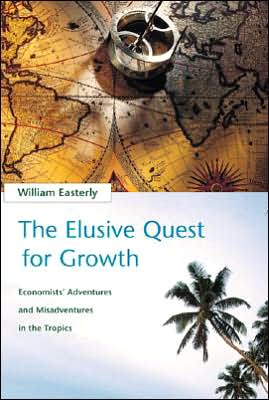
 Overview
Since the end of World War II, economicsts have tried to figure out how poor countries in the tropics could attain standards of living approaching those of countries in Europe and North America. A myriad of remedies has not delivered the solutions promised. The problem is not the failure of economics, William Easterly argues, but the failure to apply economic principle to practical policy work.
In this book, Easterly shows how these solutions all violate the basic principle of economics, that people-private individuals and businesses, government officials, even aid donors-respond to incentives. Written in an accessible, at times irreverent, style, Easterly’s book combines modern growth theory with anecdotes from his fieldwork for the World Bank.
“The Elusive Quest for Growth is a terrific book. Those who read it will put it down chastened, instructed and entertained.” -The Economist
“This is impossible to convey the depth and range of The Elusive Quest for Growth. Not only does it offer a persuasive argument but it summarizes, readably, a vast amount of research, making it come to life with real-world examples.” -Bruce Bartlett, Wall Street Journal
This is a brilliant, original work. It is simply the best book I know of on economic development. Easterly writes with clarity, honesty, and humor. And he is courageous in his analysis of what went wrong with the development policies followed by the World Bank.” -Sergio Rebelo, Tokai Bank Distinguished Professor of International Finance, Kellogg Graduate School of Management, Northwestern University
“Every college student who protests against free trade…should read this extraordinary book. Easterly presents both the power of simple economic models of the development process and the painfully disappointing track record of official development assistance. He writes beautifully and cares deeply about his subject.”-Paul Romer, Graduate School of Business, Stanford
“William Easterly knows his way not only around economics but also around the developing world. He has written hard-nosed book about the hardest problem of all; how to get the poorest countries on a path of sustained growth.” –Robert M. Solow, Institute Professor of Economics, Emeritus, Massachusetts Institute of Technology, and Nobel Laureate in Economics (1987)
“[Easterly] wears the good-humored but weary resignation of a lifetime idealist mugged at last by reality.” -Ken Ringle, Washington Post
Source http://www.nyu.edu/fas/institute/dri/Easterly/index.html
Depuis la fin de la Seconde Guerre mondiale, les économistes ont cherché à comprendre comment les pays pauvres pourraient rejoindre le niveau de vie des pays développés d’Europe et d’Amérique du Nord.
Ils ont inventé nombre de solutions prétendument miracles, qui ont été relayées par les politiques publiques d’aide au développement, mais dont aucune n’a tenu ses promesses : l’écart entre les pays riches et les pays en voie de développement n’a cessé de se creuser. Pourquoi ces échecs répétés et d’autant plus graves qu’il s’agit de vies humaines et de peuples entiers ? A travers analyses, récits et anecdotes vécues, ce livre est une critique pénétrante des politiques d’aide au développement qui ont été mises en œuvre un peu partout dans le monde, principalement sous l’égide du FMI et de la Banque mondiale, et des théories de la croissance qui les sous-tendent.
Mais il ne s’arrête pas là et explore les solutions possibles pour sortir du sous-développement.
Cours de Rémi BACHELET, Maître de conférences http://rb.ec-lille.fr
Gestion de projet, sociologie des organisations, recueil, analyse et traitement de données, prévention du plagiat, module de marchés financiers, cours de qualité et méthodes de résolution de problèmes, établir des cartes conceptuelles, utiliser Wikipédia, MediaWiki et CentraleWiki, formation au coaching pédagogique et à l’encadrement. Un cours de référencement / SEO.
Master Recherche en Génie Industriel
Recherche et scolarité ECLille :
- L’index des textes et articles relatifs à ma thèse et à mes autres activités de recherche, page alternative réf
- Pour les élèves de Centrale, voici l’entrée de CentraleWiki.
- Quelques conseils et fichiers pour corriger rapidement les QCM.
- Blog de Wikimédia France : pour répondre aux critiques de Wikipédia.
Convergences 2015, un forum de réflexion pour relancer la lutte contre la pauvreté. 800 experts issus des domaines de l’économie sociale, de la finance, de la société civile et des nouvelles technologies se réuniront en tables rondes les 25 & 26 mai 2010 pour échanger sur les thèmes suivants :
– Structurer et financer le social business pour la prochaine décennie
– Microfinance, revenir à l’essentiel : Impact durable pour les plus pauvres
– Développement économique et microfinance en Afrique : comment aller de l’avant ?
– Réinsertion et création d’entreprise : développer le microcrédit en France
Des discours seront prononcés en assemblée plénière, et un grand débat sur l’avenir du développement clôturera la journée. Plus d’informations sur Convergences 2015
On May 25th and 26th, 2010, 800 experts from the sectors of social business, finance, civil society and new technologies will be meeting in various workshops focusing on the following issues :
How to structure and finance social business for the next decade
Microfinance, back to basics: long-term value to low-income clients
Microfinance and development in Africa : how to move forward?
Reinsertion and business creation: developing microcredit in France
Speeches will be given during the plenary session, and a “great debate” on the outlooks of development will close the day.
http://www.convergences2015.org/
En route vers le sommet des Objectifs du Millénaire pour le Développement
Le 19 mai, rencontre-débat avec Bernard Kouchner, Ministre des Affaires étrangères et européennes, autour des Objectifs du Millénaire pour le Développement. L’occasion de dresser un bilan et de dessiner des perspectives en prévision du Sommet des Nations-Unies de septembre 2010 à New-York.
La Campagne Huit Fois Oui: Huitfoisoui est une exposition qui présente les huit objectifs définis par la communauté internationale (ONU) pour favoriser le développement et lutter contre la pauvreté d’ici à 2015.
Le MAEE & l’AFD Le Ministère des Affaires étrangères et européennes – MAEE lancé officiellement le 10 septembre 2008 une campagne de sensibilisation sur l’aide au développement intitulée : huitfoisoui ; et lui a apporté son soutien financier. en savoir plusL’agence Française de Développement – AFDL’Agence Française de Développement (AFD) s’associe à la campagne et prend part plus largement à la communication sur l’aide au développement. en savoir plus
Sensibiliser les citoyens : une nécessité Les conclusions du dernier CICID (Comité interministériel pour la coopération internationale et le développement) qui s’est tenu le 5 juin 2009, viennent de réaffirmer la nécessité de mieux sensibiliser l’opinion publique aux enjeux du développement. Il a pour cela demandé le renforcement des actions de communication, de sensibilisation et d’éducation au développement en direction des citoyens.
L’objectif de la campagne huitfoisoui est de faire connaître au grand public : Les 8 Objectifs du Millénaire pour le développement ; Plus largement sensibiliser sur les enjeux de la solidarité nord-sud ; informer les citoyens français sur les mécanismes d’aide au développement. Présenter l’ensemble des acteurs publics et privés français et internationaux qui agissent en faveur du développement et plus spécifiquement qui contribuent à la réalisation des ces 8 objectifs : ONG, secteurs privés, fondations, institutions publiques, bailleurs de fonds, collectivités locales, partenaires sociaux.
Comment ?
Un kit d’exposition au service des établissements scolaires et des collectivités, une présence sur le terrain, un livre, un film… autant d’actions pour sensibiliser le grand public.
HUIT : LE BLOG
Septembre 2010 : les OMD au cœur d’un sommet à New York
Comment lutter contre la pauvreté dans le monde à votre façon ?Gapminder et les Objectifs du Millénaire
Liens utiles
Source : http://www.afd.fr/jahia/Jahia/home/publications/liens
Mise à jour : Avril 2010
Les liens présentés ici n’ont nulle prétention d’exhaustivité, ni ne se prétendent les plus pertinents sur chaque sujet. Nous avons cependant classé les sites présentés. Ainsi, les premiers niveaux de classement correspondent aux thématiques propres aux organismes de développement.
Il est possible que certaines de ces adresses deviennent invalides, voire sans intérêt. Nous vous remercions de bien vouloir nous en informer.
Vous pouvez également nous faire connaître toutes suggestions permettant d’enrichir cette liste de liens : liens@afd.fr
Compte tenu de l’ évolution des sites Internet, l’AFD ne peut être responsable de la teneur des sites proposés en liens.
Pour votre confort d’utilisation, vous pouvez vous servir de la fonction rechercher de votre navigateur (menu Edition ou Ctrl F).
Sommaire
C. DEVELOPPEMENT LOCAL ET DECENTRALISATION
D. DEVELOPPEMENT URBAIN, TRANSPORT, TOURISME
H. RESPONSABILITE SOCIALE ET ENVIRONNEMENTALE
I5. AGROALIMENTAIRE ET SCIENCE DU VIVANT
II. LES ACTEURS DU DEVELOPPEMENT
A1. LES ORGANISMES DU SYSTEME DES NATIONS UNIES
A2. LES INSTITUTIONS FINANCIERES
A3. LES BAILLEURS DE FONDS MEMBRES EDFI
A4. LES BAILLEURS BILATERAUX MEMBRES INTERACT
A5. AUTRES BAILLEURS BILATERAUX
F2. INTERMEDIATION-REGLEMENTATION
F3. MARCHES FINANCIERS ET BOURSES DE VALEURS
IV. CENTRES DE RECHERCHE EN DEVELOPPEMENT ET EN RELATIONS INTERNATIONALES
B. DEVELOPPEMENT ET RELATIONS INTERNATIONALES
VI. COOPERATIONS, INTEGRATIONS, INFORMATIONS REGIONALES
Possibilités de financement
Le CRDI finance des activités de recherche qui visent à bénéficier directement aux pays en développement et à leur population. Vous trouverez dans les pages suivantes de l’information utile pour la présentation d’une demande d’aide financière et pour la gestion des fonds reçus. La première section présente des lignes directrices à l’intention des chercheurs qui souhaitent communiquer avec le CRDI pour obtenir son soutien financier. La deuxième section contient des renseignements sur les bourses de formation offertes par le CRDI ainsi que sur les programmes de partenariat du CRDI.
Veuillez suivre les liens ci-dessous pour obtenir plus de renseignements sur les sujets indiqués.
Comment présenter une demande de financement au CRDI
Vous trouverez ici des instructions détaillées pour soumettre des idées et des propositions de projet complètes, ainsi que les formulaires nécessaires.
Offre à la prochaine génération de chercheurs canadiens et étrangers la possibilité de s’adonner à la recherche au service du développement international
Administration des projets, consultations et déplacements
Aide et conseils sur la gestion de projets à l’intention des bénéficiaires des subventions du CRDI et information sur les modalités administratives et financières que les institutions et les particuliers sont tenus de respecter pour gérer les fonds reçus du CRDI.
Soutient les universités et organismes canadiens, notamment des associations professionnelles et des organisations non gouvernementales, qui mènent des recherches visant à résoudre des problèmes de développement international
Source : http://www.idrc.ca/fr
- Publicaciones BM http://www.bancomundial.org/publicaciones/
- Publicaciones BID http://www.iadb.org/publications/index.cfm?lang=es
- Publicaciones OMS http://www.who.int/publications/es/
- Publicaciones ONU http://www.un.org/es/publications/
- Publicaciones OPS http://publicaciones.ops.org.ar/publicaciones/index.html
- Publicaciones CEPAL http://www.eclac.org/publicaciones/
- Instituto del FMI http://www.imf.org/external/np/ins/spanish/index.htm
- Publicaciones OECD http://www.oecd.org/publications/
- Las Empresas de Servicios Publicos y el Arbitraje Internacional Fabiana Zonis, La Ley 24 de junio 2004.
- Inter American Trade Report «Privatized Public Utilities and International Arbitration” Fabiana Zonis, Inter-American Trade Report, Vol. 11, No. 9. October 2004.
- El Economista“Las demandas contra el Estado Nacional: un difícil desafío para el Gobierno” Fabiana Zonis, El Economista, 23 de julio del 2004.


Solicitamos cooperación para La Fundación Misión Vida para Colombia, por el rescate de los niños, jóvenes y personas que están en las drogas, delincuencia, presos en las cárceles y donde ya no reciben uno mas, objetivos en lo Espiritual y Humano para llevar nuestros programas ya diseñados a las comunidades en las diferentes ciudades de lo cual se necesitan los Recursos Necesarios, para re socializarlos brindándoles una Edcucacion Acertada y generación y creación de Fuentes de ingresos. Dios los bendiga esperando su generosa respuesta a esta causa.
Me gustaMe gusta
ME GUSTARÍA SABER SI EN VENEZUELA HAY ALGUNA FUNDACIÓN QUE TRABAJE O VAYA A TRABAJAR CON FINANCIAMIENTO DE PROYECTOS? SI EXISTE COMO SE LLAMA? DONDE UBICARLA? DESDE CUANDO EXISTE?
Me gustaMe gusta
Como puedo comunicarme para presentar un proyecto de educación en Costa Rica.
Me gustaMe gusta
Thelma , te recomiendo leer el apartado «quienes somos» para que entiendas de qué se trata este blog.
Saludos
Me gustaMe gusta
Hola !les dejo para que visiten este sitio seguros para autos
Saludos!!!
Me gustaMe gusta
Muy buena informacion de contactos de organizaciones internacionales para lograr apoyo a propuestas locales. Felicitaciones
Me gustaMe gusta
De antemano agradecerles el gran esfuerzo por orientar a las organizaciones sin ánimo de lucro en esta infinidad de fuentes de cooperación
Me gustaría saber si usted me puede indicar por favor con un poco más de precisión donde puedeo presentar un proyecto para la compra de una sede de un alberque para esquizofrenicos estrato 1 que funciona hace varios años en una casa alquilada en Bogotá Colombia.
Gracias
Roberto Suárez
Me gustaMe gusta
RUBEN OMAR ESPARZA
31/07/12 Desde Mar Del Plata PCIA de Buenos Aires Argentina
Me dirijo a traves de este comentario, a quien tenga el poder de decidir sobre el Proyecto R.E.C.U.P.E.R.A.Lo cual detallare a continuacion exponiendo un breve comentario.
Un dia recorriendo las paginas de Internet, en las paginas de sub-sidios no reembolsables, me encontre con la de Peoyecto Milenio.
Loque me causo, una gran alegria, ya que soy egresado de un seminario dictado en la fundacion Empretec, en argentina.
Y da la casualidad de que los que apadrinan a dicha fundacion son en muchos casos los mismos que lo hacen con Proyecto Milenio.
entonces no dude nu instante, en enviar este mensaje, apesar que ya lo intente en otras oportunidades.
Lo que quiero saber ahora, es , que sabiendo el nombre de la persona, con la cual me tengo que contactar(Miguel Angel Gutierrez) donde lo encuentro,
Para empezar a dialogar personalmente sobre el Proyecto R.E.C.U.P.E.R.A
El cual asi como la primer silaba de la sigla, lo indica (R),se trata de reciclar
lo que expondre ampliado , el dia que se concrete la entrevista personal.
para lo cual les dejo mas datos, mi celular (0223)154428656.mi nextel 621*998 mi mail proyectorecupera@hotmail.com.ar
Me despido de ustedes sin mas,(por ahora) con un fuerte abrazo, determinando la respuesta rapida y favorable.
Ruben Omar Esparza
Peon de Tareas Generales.
Me gustaMe gusta
SOY EL AUTOR DE UN PROYECTO DE ECOLOGIA APUNTANDO MAS QUE A NADA AL RECICLADO DE REZAGOS DOMICILIARIOS , EN LA ULTIMA ETAPA , COMO HASTA AHORA SOLO HEMOS VISTO Y OIDO QUE EXISTEN SECRETARIAS Y OFICINAS DE TODO TIPO POR TODO EL MUNDO, EN CUANTO A BARRIO ,DISTRITO , PROVINCIA O A PAIS SE REFIERA , PERO QUE QUIZAS NO SEA LO SUFICIENTE LO QUE SE HAYA CREADO HASTA AHORA . POR ESO ME TOMO EL ATREVIMIENTO DE SOLICITAR , POR MEDIO DE QUIEN CORRESPONDA , UN SUBSIDIO DE FONDOS NO REEMBOLSABLES, PARA DESTINARLO AL ARMADO DE LA GRAN MAQUINARIA , QUE HASTA AHORA PENSABA QUE LA PODRIA PONER EN MARCHA YO SOLO , CON GRAN ESFUERZO , TAL COMO LO VENGO HACIENDO HASTA AHORA. PERO COMO VEO QUE SE HAN REUNIDO TANTAS ENTIDADES CON FONDOS SUFICIENTES COMO PARA DARME EL APOYO QUE REQUIERO, ME VEO OBLIGADO ENTRAR EN CONTACTO A TRAVES DE ESTE MEDIO , PARA DETERMINAR LA RESPUESTA FAVORABLE QUE ESPERARE SE CONCRETE LO MAS PRONTO POSIBLE, POR QUE SE QUE HAN SIDO CREADAS PARA TALES FINES.
SALUDA ATTE
RUBEN OMAR ESPARZA
Me gustaMe gusta
La FUNDACION ESPERANZA MUNDIAL, tiene como misión, Construir un centro hospital, para beneficiar a mas de 30,000 habitantes de este sector de el Valle del Cauca, un Jardin infantil donde se le brinde un mejor nivel de vida a los niños y niñas de o meses a cinco años, Segunda infancia y adolencia.Educación, vivienda, y trabajar duro por la recuperación del medio ambiente, formación y empleo para las madres y padres cabeza de familia, que son los que mas sufren, necesitamos construir una casa para el adulto mayor donde su alimentacion el techo y la salud sea infalible para estas personas donde el sufrimiento es el pan de cada Dia para ellos, por favor ayudenos a ayudar, un grano de arena para nosotros es una bendición.
Estamos organizando a los campesinos, queremos que cultiven, que se inclinen por el plan de la agroindustrial, Etc. para poder alcanzar nuestra mision y visión hemos estructurado una serie de proyectos y procesos operativos siguiendo la secuencia de relación causa y efecto.
Agradecemos por su apoyo su colaboración y generocidad, de nosotros depende que nuestras familias vulnerables en alto riezgo paren de sufrir.
recibimos contestación en nuestro e-mail- fesmundial@hotmail.com o al tel. 3188520624, Noralba Carrillo subdirectora, con su apoyo nuestros niños y niñas y toda la comunidad dejaran de sufrir.
Me gustaMe gusta
Saludos desde ECUADOR-PUYO, felicitaciones por su labor en protección al medio ambiente, sabiendo que un arbol = una vida, es muy importante erradicar la tala de arboles con el fin de hacer papel, ocupemos la otra alternativa el BAGAZO DE CAÑA PARA HACER PAPEL, de esta manera contribuiremos con el medio ambiente como tambien con la salud sabiendo que en la actualidad en las panaderias del Ecuador, ocupan la funda plastica (el plastico contiene BISFENOL COMPUESTO ALTAMENTE CANCERIGENO SEGUN CRITERIO CIENTIFICO) para vender el pan,,la PYME FAMILIAR PUBLI-GREEN ,pretende hacer disponible las fundas de PAPEL DE BAGAZO DE CAÑA. solicitamos a AVINA apoyo para esta iniciativa. netamente ecologica UNICA EN EL ECUADOR. PARTICULARMENTE EN PUYO. esperamos su contestacion. movi.098-316-890. Lic. Hector Tituaña.
Me gustaMe gusta
somos una organizacion de jovenes garifunas de honduras legalmente constituida sin fines de lugro quicieramos saber sobre fondos para financiar cualquer proyecto para jovenes ya que las organizaciones locales no nos tomamn en cuenta
Me gustaMe gusta
Sres. buenas noches
El objetivo es solicitarles informacion ya que iniciamos un pequeño grupo de mujeres en el sector de Santa Rita Yoro con el proposito de ser una fuente generadora de ingresos para nuestras familias y vecinos del sector, deseamos nos puedan asesorar para poder accesar a financiamiento para proyectos comunitarios.
Bendiciones
Karen Castellanos.
Me gustaMe gusta
Yo integro la comision de finanzas de la iglesia catolica de un pequeño barrio en Cr tenemos como proyecto la construcción de la torre al pequeño templo que tenemos, me gustaria saber si hay fundaciones que nos pueden ayudar a finalizar el proyecto ya sea con la ayuda con materiales o economicamente.
saludos
Me gustaMe gusta
«CORPORACION DE DESARROLLO SINCOS» ES UNA ORGANIZACION SIN FINES DE LUCRO, NUESTRO ONJETIVO ES TRABAJAR POR EL DESARROLLO SOCIO-ECONOMICO DE LOS PUEBLOS ALTOANDINOS DEL PERU
DESEARIAMOS RECIBIR ORIENTACION PARA CONTACTAR CON LAS ORGANIZACIONES QUE PUEDAN ASESORARNOS Y APOYARNOS EN NUESTRO OBJETIVO DE BUSCAR MEJOR CALIDAD DE VIDAD PARA LA POBLACION UBICADA EN LA ZONA ALTINA DEL VALLE DEL MANTARO REGION JUNIN PERU.
A LA FECHA, EL PRIMER ESFUERZO ESTAMOS ORIENTADO A DESARROLLAR UN PROYECTO DE TURISMO VIVENCIAL SOSTENIBLE, APROVECHANDO LOS RECURSOS TURISTICOS DE LA ZONA Y PONERLOS EN VALOR, E INCORPORAR A LOS POBLADORES EN EL DESARROLLO DE CAPACIDADES PARA BRINDAR SERVICIOS A LOS TURISTAS.
Me gustaMe gusta
Contodo respeto les recomiendo Visitar http://www.adlumen.org. unica aplicacion del Marco logico en tiempo real.
Gracias
Me gustaMe gusta
somos la fundacion Jovenes en Accion la cual le soliciata a ustedes del, Proyecto Milenioes sitios redes e informacion actualizada sobre cooperación internacional (convocatorias de becas, fondos y noticias relativas a la cooperación internacional y financiamiento de proyectos).
Me gustaMe gusta
Somos una organizacion sin animo de lucro constituido con el objeto de trabajar y aportar al mejoramiento de la calidad de vida a traves del desarrollo sostenible y ambental en diferentes grupos poblacionales.
La corporacion Yanapaqui, trabaja a traves de tres departamentos con el objetivo que los planes programas y proyectos brinden soluciones a las diferentes problematicas sociales y cumplan con el objetivo de la corporacion. los departamentos son. desarrollo social, agroecologia, y medio ambiente.
Queremos recibir aportes a nuestra organizacion para asi crecer y fortalecer nuestras actividades y asi realizar una mayor cobertura a nivel nacional e internacional
Me gustaMe gusta
Estimad@s, “Proyecto Milenio” es un sitio que intenta brindar información actualizada sobre cooperación internacional (convocatorias de becas, fondos y noticias relativas a la cooperación internacional y financiamiento de proyectos). En cada entrada siempre se especifica la “fuente”, se copia el link y un mail de contacto. Le sugiero entonces, que se ponga en contacto con el mail indicado en el artículo.
Me gustaMe gusta